Thelian tried to hate the Iru. He wanted one straight line: monster, enemy, blame. Instead his chest stuttered every time glass reflected him back.
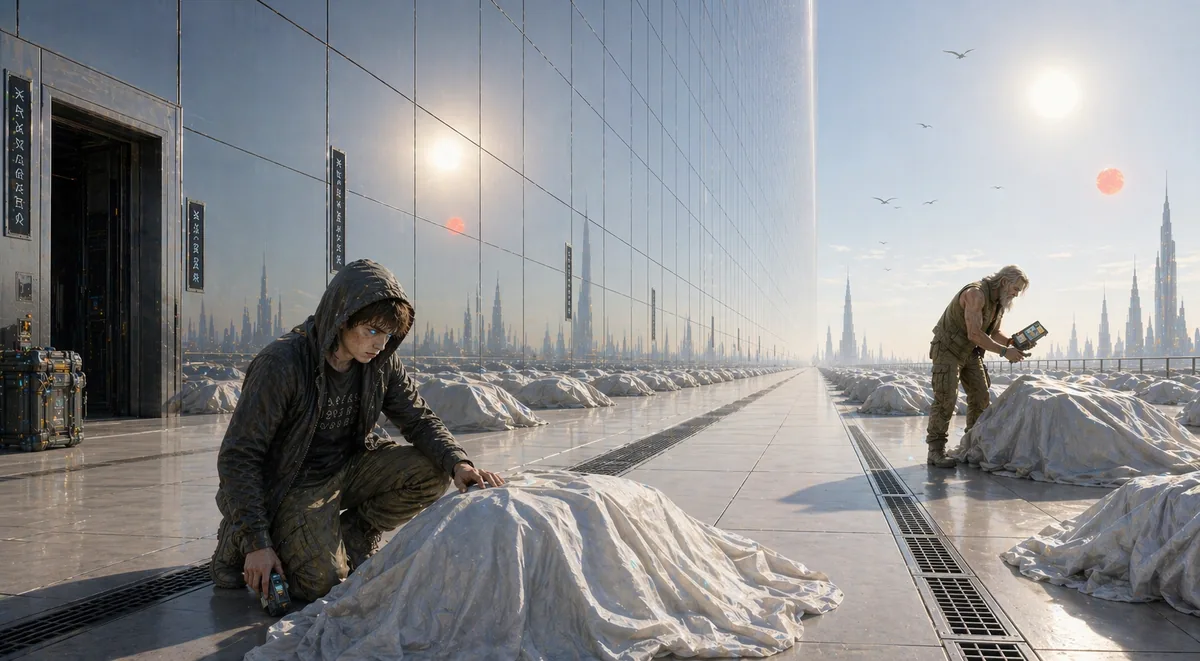
On the terrace, the air did not move. It shimmered, warped by heat. The glass wall rose behind like a clean cliff.
A maintenance shed squatted at the terrace edge, more box than building, patched with cheap metal panels and sealant lines that looked like old scars. The doorway was in shadow, and that shadow was the only cool thing on the whole floor.
Aeron leaned in it like he belonged to the frame. Like the building had grown him there as a hinge.
Aeron smelled of smoke and cheap tea. The familiarity landed harder than expected. Same hooked nose, same tight mouth. Same eyes that did not flinch when they met blue.
“You’re late as hell.”
“No lift.”
“Try being old, for fuck’s sake. Now move.”
Thelian stepped past him into the shed shadow and felt his skin loosen by a fraction, as if the heat had been a fist holding him. The shed held tarps, bins, and tools. Aeron reached for a scanner and a clipboard . His hands were sure, fingers stained with dark residue that never scrubbed all the way out. A butcher’s hands, but not the kind that made speeches.
He shoved the scanner into Thelian’s palm.
“Double-check the tags, match the registry. Standard clearance,” Aeron said. “We clear the yard by tonight, hell and back if we have to.”
Thelian didn’t answer. Answering would have meant air, and his lungs already felt like paper. He took the tools because taking tools was a rule. Rules were safer than thoughts.
Aeron squinted at the clipboard, then at the yard, then at Thelian’s face.
“You eat, kid?”
Thelian’s throat worked once. His stomach tried to tighten into a knot and failed because it was too empty for knotting.
“Yes,” he lied, and hated himself for it because Aeron would have known anyway.
Aeron grunted, as if the lie was not worth the trouble of calling out. He turned and stepped into the blaze without shielding his eyes, his back straight, boots scuffing over concrete. He moved like a man who had long ago stopped asking the world to be kind.
Thelian followed because there was nowhere else to put his body.
The yard was not really a yard. It was a terrace meant for air and view, for clean citizens to stand and talk and point at the city below. Now it was stripped of that pretense and used like everything else, repurposed into a function. Rows of tarp-covered shapes lay on the concrete in long lines, each one tagged, each one numbered, each one waiting for the next part of the system to admit it.
Thelian raised the scanner and forced his hand to stop shaking.
The first tarp was light, the fabric snapping as he pulled it back. Heat rolled out from beneath, trapped and sour. The face under it was pale, too smooth, the skin stretched tight like wax left too close to a flame. A sleeping face, if you wanted to lie. A dead face, if you wanted to be honest. Thelian’s eyes flicked to the tag tied to the wrist with thin plastic twine.
He scanned. The scanner chirped.
He looked down at the clipboard, found the number, matched it, then wrote the check mark with a pen that scratched. The pen line looked too bright against the paper, too clean.
He pulled the tarp back over the face and moved to the next.
Scan. Chirp. Match. Mark.
He worked because working was a rule. He worked because if his hands were busy, his head had less space. He worked because Aeron was watching in the way Aeron watched, not like a guard, not like a supervisor, but like the job itself looking through an old man’s eyes to see if you were going to make it harder.
Most of the tarps hid Iru.
The empire’s forgotten heart, now laid out in neat rows across a terrace like cargo. Once-mighty, people said, as if Thelian had ever seen them mighty. He had seen them in glass pods, suspended, their strange bodies still and pale. He had seen their faces in propaganda plaques, pointed ears stylized into elegant curves, eyes drawn in flattering soft ink. He had seen Iru in whispered stories, in Harri’s spit-words when he wanted to scare him quiet.
Demon.
The word had been thrown at him too. Not for what he was, but for what his eyes did when light found them. The blue shame. The thing he could not scrub out.
The tarps lifted and fell. Faces showed. Some twitched, the kind of movement that made people say not dead, not yet, sleeping. Thelian did not say it. He had seen sleepers wake: convulsion, mouth open, sound dying. Aeron had told him to look at hands, not faces. Hands were safer.
Thelian looked at hands now. Long fingers, nails too clean. He tried to build hate out of cleanliness, out of bodies that had never fought for air. He tried to remember Elle’s hands, small and hot, burning with fever.
It did not sharpen.
Fifty-seven bodies later, he found her.
Not Elle.
But close.
He pulled the tarp back and the world narrowed to one small shape on the concrete.
She was smaller than the others. A girl. Heat had flushed her skin in ugly patches. Her mouth was open. Her hair was damp.
It was the hands that hit him first.
Small, perfect hands, fingers curled as if holding something. The sight of them landed behind his ribs before thought. Soft cheeks. Lashes resting like they were protecting a dream.
Elle had not looked like this at the end. This girl looked like Elle if fever had been kind.
Thelian’s breath went thin.
Then he saw the eyelid.
The lid of her right eye had fluttered open, just a crack.
Blue.
Deep, vivid, chemical blue, so bright it looked wrong in the sun, like a flame held steady in water. The color of the mirror in the Medika. The color of the tiny spark he had seen in a cut wire when he broke the door’s nerves. The color that had betrayed him under a lamp beam, made a guard’s voice change.
The scanner went slack in his grip. His hand forgot it was holding anything.
Demon, the world said.
Sickness, Harri said.
Monster, the guards said.
Thelian stared down at her and saw no monster. He saw a mirror that was not broken. He saw the same eyes he had spent his life hiding, set in a face that looked like the only person who had ever loved him without charging for it.
His mother’s face rose up, not as a full picture, just a fragment. Her thumb brushing the corner of his eye when he was little. The brief stillness before she smiled.
Elle came after, then her, then the debt. Each one a weight.
He looked back at the girl on the concrete.
She is not a demon, the thought slammed into him, absolute and terrifying.
She is just small.
Her chest hitched.
A tiny, shallow movement. So slight he almost convinced himself he had imagined it. Then again, a little flutter, like a Socly trapped in a hand.
Alive. Barely.
“Aeron,” Thelian said.
His own voice sounded wrong to him, scraped hollow, like it had been sanded down.
Aeron did not look up from his row. He was crouched by a tarp, hands efficient, scanner in his own grip, pen already moving. “What is it, what the hell?”
Thelian swallowed. His tongue felt too big for his mouth.
“I’m done with this row.”
Aeron’s pen stopped. He straightened slowly, as if his bones had to negotiate each movement. He turned his head and looked at Thelian across the bright yard. One brow lifted, more tired than surprised.
“That so, fuck?”
The old man wiped sweat from his forehead with a sleeve that had long ago given up being clean. The smear left a dark stripe.
“Well, it’s noon,” Aeron said. “I’m getting lunch. Cafeteria’s serving sludge again, but it’s hot as hell.”
He eyed Thelian harder.
“You coming? You look like you’re gonna fall over, for fuck’s sake.”
Thelian shook his head.
“No. I’ll sit here. Wait for you.”
He did not say the real reason. He did not say he had no credits left. He had spent what he stole on a tree and a lie, and there had been nothing left afterward, just paper proof and a hollow stomach. He did not say that if he walked into the cafeteria, he would have to meet eyes, and eyes always found him. He did not say that he could not leave the girl on the concrete under the sun.
“Suit yourself, kid, hell knows,” Aeron said.
He hitched his belt, a gesture that looked like a ritual, like tightening a strap on armor before going to battle.
“Don’t let the flyer’s get ‘em, beastcrap as they are.”
Aeron walked away. Boots scuffing the concrete. The heat swallowed him. He disappeared into the shadow of the access corridor that led back into the arcology’s belly, where the air was colder and the walls did not throw light back.
Thelian stood still until Aeron was gone.
Then he dropped to his knees beside the girl.
The concrete was so hot it bit through his trousers. Pain lanced up into his thigh. He did not move away from it. The pain gave him something simple.
He leaned close. The girl’s skin radiated sun heat, trapped under tarp. Her lips were dry. A faint crust of salt and dust clung at the corners.
He touched two fingers to her neck the way he had seen Medika techs do it, the way he had seen Aeron do it when a pod looked wrong. He found a pulse, thin and fast, like a trapped animal.
He looked around wildly.
No shade. No water. Rows of the sleeping dead and the concrete baking in the heat. The maintenance shed shadow was too small. The access corridor was too far, and he could not carry her down into a place with guards and eyes and questions. The gliders circled overhead. One of them let out a rasping cry and dipped again, testing.
He needed cold.
He needed a place where things stopped dying.
He hooked his arms under the girl’s shoulders and lifted.
She was heavier than Elle, built denser. Her head lolled when he raised her. He pulled her against his chest, her body a length from collarbone to thigh.
He moved fast toward the service entrance, where cold air spilled out.
He crossed into it and felt his skin tighten, gooseflesh rising on arms that were already damp. The cool air tasted stale, recycled too many times, but it was still cooler than the sun’s fist.
Inside, the corridor was bright, white, too clean. The Medika’s smell, but cheaper.
He moved deeper, away from the terrace doors, into a side passage where maintenance carts were sometimes parked. An overthrown large office desk lay on its side near the wall, abandoned like a dead animal. A stack of crates sat beside it, sealed and labeled in neat print. Thelian did not read the labels. He did not have time.
He lowered the girl to the floor in the shadow behind the desk, where the air was cooler and the light did not hit her face directly. Her chest fluttered again. Her eyelid did not close.
Thelian’s hands hovered over her for a second, as if he could push the heat out of her with his palms.
His foot kicked something.
A clatter. Plastic on stone.
The sound snapped through the corridor, too loud in the sterile air. Thelian froze, head tilting, listening for answering footsteps.
Nothing.
Silence in this place had teeth. Silence waited.
He looked down.
A card lay in the dust near a wall seam.
It did not look like the modern access passes trainees wore on cheap lanyards. It was thicker, the edges worn smooth by handling. The surface was scratched. The print was faded. It looked like something that had lived through too many seasons to still belong.
He picked it up.
The plastic was cool against his sweat-damp fingers.
The script on it was hand-written, messy, scrawled in black marker over the original faded print. It was New Arram script, but the handwriting was jagged, like someone had written in a hurry with a bad pen, or like their hand had not been made for writing.
Annil Maintenance Master Key.
The words made his mouth go dry.
Annil.
Aeron had spoken the word once, months ago, when a trainee had asked about the sealed floors below the Sleepers. Aeron had not explained. He had just said, “Annil made things that still work. Don’t touch what you don’t understand,” and then gone back to pulling tubes like the question had been a fly.
Thelian stared at the card, then at the wall where it had been lying.
The dust there was disturbed.
Small marks. Not boots. Not shoes. Small, wide prints with claw-tips, pressed into the dust like a stamp. They led directly into the blank concrete panel and stopped.
A door, Thelian thought.
Doors have secrets.
His eyes flicked back to the girl behind the desk. Her breathing had become a faint rattle now, like air scraping over something rough. Her lips parted a little wider. The blue of her eye caught the light and held it.
He did not think.
He did not plan.
His hands were already moving. His feet had already decided. The muscles knew before the mind caught up, the way hands knew bread, the way fingers knew thread. His lips shaped two words without choosing them. Uhiel high. The syllables rose like reflex, like swallowing, like flinching from a flame.
He pressed the card against the concrete panel.
For a heartbeat, nothing happened.
Then there was a click, low and mechanical. A grind of stone on stone. The sound made his shoulder prickle, made his body remember alarms and guards, made his breath hitch.
The wall hissed and popped open a finger’s width.
Cool, stale air bled out, smelling of mold and old machines. It smelled like a basement that had not seen light in years. It smelled like hidden.
Thelian jammed his fingers into the gap and pulled.
The panel resisted, then slid, heavy and reluctant, as if it had not been opened in a long time and did not like being reminded it could move. His nails scraped. The seam widened.
Inside, it was dark.
The air that rolled out was delicious, cold and damp, a mouth exhaling.
Thelian lifted the girl again, gritting his teeth as the weight pulled at him. He stepped into the dark and pulled her in after him, then shoved the panel back until it sealed with a soft, final click.
The corridor’s clean hum vanished.
Silence settled, thicker here, more honest. The air tasted old, like metal and stagnant water.
His eyes adjusted slowly.
In the center of the room, bathed in the faint green glow of a control console, stood a glass pillar.
A hibernation pod.
Thelian’s heart hammered against his ribs hard enough that he felt it in his throat.
The pod was occupied.
Two bodies in one space, suspended in bluish liquid. An Iru male and a Maan female. Their faces were slack, peaceful, like they had slept through the end of the world.
Thelian stood still, the girl’s weight sagging in his arms. The cold air made his sweat chill. His skin tightened. His fingers ached around the girl’s ribs.
The girl twitched, a small spasm. Her head lolled. A dry sound scraped from her throat.
He looked at her, then at the sleepers.
She would fit between them.
The thought came in, sharp and clean, and with it a sick twist in his stomach.
He laid the girl on the floor gently, as gently as he could with hands that shook. Her hair spread on the cold tile. Her blue eye stared up at nothing.
He turned to the console.
The writing on it was old, Ilso script. Sharp and incomprehensible. But he had watched Aeron shut down pods a hundred times. Red to green. Twist. Pull. He reversed it in his head.
He found the manual release latch at the base of the pod, a metal handle recessed into the console’s belly. His fingers closed around it. Cold metal bit his palm.
He yanked.
The seal broke with a wet gasp.
Fluid drained away with a gurgling rush, pouring into floor grates that swallowed it greedily. The glass front hissed and unlatched. The sound of pressure equalizing filled the room like a sigh.
The bodies inside sagged.
The Maan woman slumped forward, heavy and limp, smelling of chemicals and stale fluid. Thelian pushed her back, bracing his shoulder against the pod frame.
He tried to fit the girl in anyway, lifting her limp body, angling her legs, searching for a gap.
There was no place.
The pod had been built for one. Two was already a theft.
His hands hesitated.
He looked at the Iru man.
He did not look at his face. He could not.
He grabbed under the man’s arms and hauled. His hands did something they could not undo, and his hands did not wait for permission.
The body came free with a horrible suction sound, like pulling something out of mud. The man’s head lolled. His hair dripped. His arms swung bonelessly. Thelian’s boots slipped on the wet tile. He caught the body before it fell. The Iru man’s frame, stretched nearly half again longer than Thelian’s own, made every step an awkward geometry problem.
He dragged.
The pod room was small. Every scrape sounded loud. The body left a smear of blue liquid across the floor. Thelian’s breath came fast in the cold air, and the sound of it felt like guilt.
He reached the false wall panel. He pressed the magnet card against it again, fingers trembling.
Click.
The panel slid open.
Cold air leaked out into the corridor beyond. Light spilled in, bright and accusing.
Thelian hauled the Iru man through the opening and into the clean corridor, then toward the terrace doors. Each step was a stumble. The body’s weight pulled at him like an anchor.
He did not look at the Iru man’s face. He did not let his mind build a person out of the weight he was dragging. He made it cargo, like Aeron did, like the system wanted.
The terrace heat hit him immediately.
He dragged the body across the concrete, past rows of tarps, toward the processed pile at the far side where bodies that had been cleared were stacked for transport. A glider dipped lower at the sight, hungry and hopeful, then rose again when a sensor clicked somewhere and a faint warning tone sounded.
Thelian heaved the body onto the pile.
It landed with a wet thud, limbs folding wrong.
Thelian’s throat tightened.
“Sorry,” he whispered.
“Sorry. Sorry. Sorry.”
Each different. Each imperfect.
He did not know who he was apologizing to. The man. The woman still in the pod. The girl burning behind a desk. Himself.
He turned and ran back inside before his legs could remember they were tired.
The corridor’s cool air caught him again. He nearly stumbled as his skin went from heat to cold. He forced his feet steady. He pressed the magnet card to the panel and slipped back into the dark room.
The Maan woman sagged in the pod, head tilted. Thelian shoved her back, pushing her deeper.
He scooped up the girl from the floor.
Her skin was cooler already in this room, but her mouth still rasped. Her eyelid fluttered again, the blue glinting for a heartbeat.
He lifted her into the pod.
Her head lolled against the Maan woman’s chest, cheek pressed to cold skin. The contrast made Thelian’s stomach twist. A living heat against a dead chill.
He adjusted her legs, her arms, tucking her in like a child being put to bed.
Then he slammed the glass shut.
The latch clicked.
The sound was too final.
He turned back to the console.
He did not know how to turn it on.
The Ilso script stared back at him, sharp and indifferent. Buttons. Dials. Indicator lights dead or dim. The whole thing looked like it belonged to a world where people could read.
Panic rose in his throat like bile.
Think. Watch. Remember.
Aeron's sequence: top left, center, dial.
Thelian’s hand hovered over the buttons, fingers shaking so badly he could see the tremor in the green light.
He pressed.
Top left.
Nothing.
He pressed harder, as if force could convince it.
A faint click.
He pressed center.
The console groaned. A light flickered green.
Thelian’s breath caught.
He grabbed the dial and turned it.
A hiss filled the room.
At first it sounded like air escaping a wound. Then it became steadier, a rush, as if the machine was drawing breath for the first time in ages. The glass pod fogged with condensation. Mist formed on the inside, obscuring the girl’s face. The green light reflected in the droplets, making them look like tiny eyes.
Then, from the bottom, liquid began to rise.
Clear at first, then blue-tinted, catching the console glow and turning it into something almost pretty.
It covered the girl’s feet. Her legs. Her waist. Her chest.
Thelian stepped closer, hands pressing flat to the glass.
Breathe, he told her without sound.
Don’t drown.
Sleep.
It reached her neck. Her chin. Her mouth.
The girl’s lips parted slightly, and the liquid slid over them.
Thelian’s fingers dug into the glass as if he could hold the liquid back by force.
It covered her face.
For a second, nothing happened.
The world held its breath.
Then the girl’s chest rose.
Slow.
Suspended.
Not a gasp. Not a choke. A controlled lift, as if the machine had taken over the work of breathing for her.
A light on the console pulsed.
Steady.
Alive.
Thelian’s legs went weak so fast it felt like the floor dropped out from under him. He slumped against the glass, forehead touching it, then slid down until his back hit the cold tile.
His mouth opened. No sound came out.
His hands trembled in his lap, wet with condensation and his own sweat.
He sat there for a long time.
The machine hummed. The drainage grate dripped in the dark.
He had stolen a life.
He had discarded two others to do it.
The thought did not come with words like guilt. It came as a physical weight, a pressure behind his ribs, a tightness in his throat that made swallowing hurt.
He looked at the pod.
The girl floated in blue liquid, eyes closed, the blue hidden.
Hidden.
Safe.
For now.
Thelian’s gaze dropped to his hand.
The magnet card was still there, clenched so hard it had left a pattern in his palm. Annil Maintenance Master Key. The black marker letters looked too bold in the green light.
He slipped it into his pocket, next to the foil scraps and the receipt for the tree. Plastic against paper. Old key against new proof. His pocket felt heavier, like it had gained a stone.
A faint sound came from somewhere in the room. A soft scrape, like a small thing shifting against wood.
Thelian’s head snapped up.
Silence again.
He stared into the dark corners beyond the console glow. The room was cramped, but shadows still lived in it. The air felt thicker there, damp and stale.
The sound did not repeat.
He told himself it was the building settling, metal contracting with cold, a drip hitting a hollow spot. The system made noises all the time. Machines groaned. Pipes clicked. Nothing here was alive except him and the girl in the pod, and maybe not even him, not in any way that mattered.
He forced his eyes away.
He stood up slowly, legs numb.
He checked the pod one last time.
The girl floated there, safe, hidden.
The room around it was a mess.
Blue-tinted liquid smeared the floor where he had dragged the Iru man out. Droplets clung to the pod frame. The Maan woman’s skin inside the pod had taken on a faint sheen, her hair plastered to her cheek where the liquid had washed it. The glass fogged and cleared in slow cycles.
Thelian’s hands twitched.
He looked at the mess and felt the urge to clean.
The urge was not moral. It was practical. Mess invited questions. Questions invited eyes.
He swallowed.
“Later,” he told himself, the word barely moving his lips.
He went to the false wall panel.
He pressed the card. The panel slid open. He stepped out and pulled it shut behind him. The click was too loud.
The corridor was empty.
The terrace doors were a bright rectangle at the far end. In the polished floor, he saw his own eyes mirrored, blue.
He bowed his head hard, hood shadowing his face, and moved away from the reflection.
The floor was wet where he had carried the girl in. A faint smear of blue liquid trailed from his boots.
In a panic, he started cleaning.
He yanked his jacket and scrubbed at the floor. The blue smear spread, thinning.
One.
Two.
Three.
He stopped.
Clean was wrong. Clean meant a guard would ask why. He wanted mess, not silence.
He dragged his jacket through the wetness again, but not to erase. To confuse. To break the line. He scuffed his boot through it, making random marks. He knocked a loose scrap of packing plastic from the crate stack and smeared it across the tile. He pushed the overthrown desk an inch, then shoved it back, making a new scrape line that crossed the old.
It took him almost all the lunch break.
His stomach cramped in hunger, then went numb. His hands cramped around the jacket fabric. The skin on his fingers wrinkled from wetness, cold and blue-stained.
When he finished, the corridor did not look clean.
It looked like a mess, not like before, but enough that no one could suspect something precise had happened here. The wetness was scattered. The marks were chaotic. The desk still lay overturned like it had been abandoned that way for months. The crate stack still looked untouched. The blue tint on the floor could have been a spill from a transport cart. Could have been old.
Could have been nothing.
Thelian forced his breathing to slow.
One.
Two.
Three.
He tucked his jacket back around his waist, damp and heavy now. The wet fabric slapped against his thighs as he walked, a reminder.
He slipped back out to the terrace.
Heat hit him again, brutal after the corridor’s cold. The air tasted of rot and sun-baked tarp. Gliders circled overhead, their shadows sliding over the rows like slow hands.
The processed pile was visible from where he stood.
The body he had dragged out lay under a tarp now.
Somebody, maybe a trainee passing, maybe Aeron on his way out, had thrown the tarp over it . It looked just like the others now. Just more cargo for the gliders to want.
Thelian’s mouth tightened.
He walked back to his spot in the row he had abandoned, the scanner still in his hand, the clipboard pressed against his forearm. The concrete was warm. The smell of rot was thick, sweet and sour at once. Sweat dried on his skin and left salt behind.
He lowered himself to the ground in the thin strip of shadow cast by a tarp edge.
His limbs folded beneath him like broken scaffolding.
His shoulder throbbed. His ankle ached.
His hands were stained blue at the creases. It never came out.
But the girl was cool.
That thought sat in him like a stone, heavy and steady. Cool and hidden and breathing in blue liquid, behind a wall that should have stayed shut.
He closed his eyes.
Above, the gliders screamed again, impatient.
Below his ribs, his pocket pressed back with the hard edge of the magnet card, the foil scraps, the receipt for the tree.
A weight.
A secret.
A decision that would not wash out.
And sleep took him like falling snow.