
Snow covered everything in pale silence. The wind lifted it like powder and breathed a white haze across the horizon, turning distance into breath and absence.
He stood on a mountain ridge. His feet found no floor. His weight pressed nothing. The cold was everywhere and he could not feel it, not on his skin, not in his teeth, not in the places where cold always landed first.
Thelian was dreaming.
He knew it the way you know a stair is missing in the dark. The body tells you before the mind agrees. He was meant to be on shift, neck-deep in work. Instead he stood weightless on the narrow back of the world, snow curling in whispered spirals around him. The mountains stretched like splintered spines, jagged and white.
”Why did we take the long way? We could’ve come through the southern pass!”
A voice, impatient and sharp, behind him.
Thelian turned. Or rather, something in him twisted, without feet, without mass. No weight sank into the snow. No cold bit his bones. His hands closed on nothing. His feet found no purchase.
Before him, a pale Herin snorted steaming clouds into the air. Upon it sat a figure Thelian recognized instantly, though he’d never seen one alive.
An Iru.
Real. Breathing. Not the half-dead sacks he tagged at the compound. This one rode with purpose. White skin bright against the snow. Grey hair whipping across a jaw set hard. Furs thick enough to hold shape on their own, and beneath them a body that moved like it had been doing this longer than the mountains had.
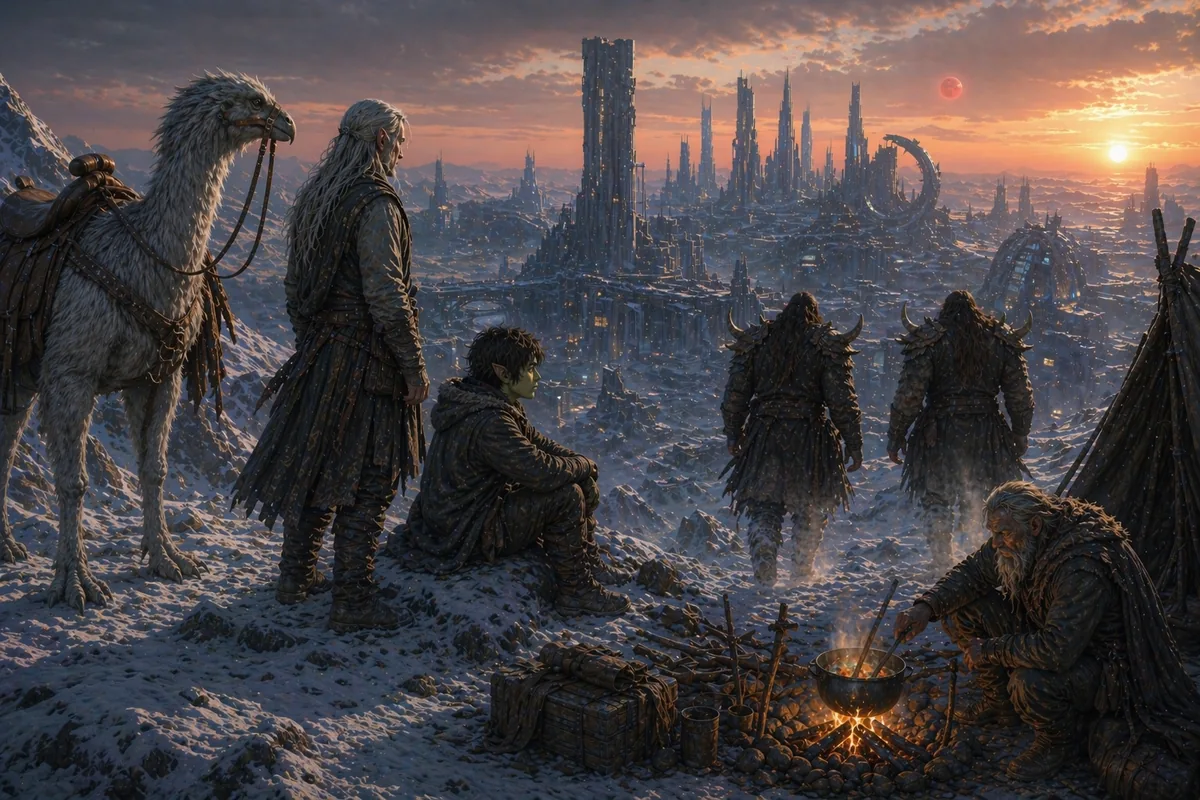
Behind him rode four more. One was small, green-skinned. A child. Two were giants, bulky and broad like walking stonework. All wore cloaks of shadow and feather-lined hide, and the two largest kept their hoods low, as if hiding weight beneath the fabric where bone should not swell. All moved like they had done this before, like they belonged to this deathless cold.
”We’d have arrived two days ago if we hadn’t dicked around in these damned hills!” shouted the green boy.
”I told you,” grumbled an old maan. ”You only enter the city from the north. Everyone in Verdeny knows that. Kobolds hold the other roads.”
”Kobolds again,” the boy muttered.
Thelian stared.
That face. The boy’s dark hair hung in shagged clumps, skin a sallow shade of moss, but the bone structure, the jaw, the narrow nose gone red from wind, it was almost his. Almost.
Everyone rode. Who would walk in this place?
The Iru led. Then the green-skinned boy. Then the old maan. Then the two immense figures, hulking and deliberate, in silence. Their riding beasts trudged up the slope, hooves punching through the crusted snow with stubborn rhythm.
The path narrowed into a cragged vein along the ridge, a winding artery between broken cliffs. The peaks rose like shattered fangs, blotting out the sun. Cordae trees clung in sparse patches to the slopes like forgotten prayers, their needle-clusters dark and glossy, bending under ice without breaking, the resin-scent sharp even through the cold.
No flyers, no animals anywhere. No sound but hoofbeats and the slow shuddering breath of tired beasts.
“The ancient ones called this the Spine of the World,” the green boy said.
Thelian blinked.
”It looks like the spine of some great beast, half-swallowed by the earth,” he said aloud.
No one turned.
The boy urged his Herin forward, claws crunching deeper into the drift. The rest followed, their animals weary, reluctant. They looked like statues carved by winter, leaning uphill with effort and silence.
They were tired. The way cold seeps into joints and thoughts. But they moved still.
Forward. Always forward.
”We’re nearly there! I told you! There it is, look!” cried the maan.
And they crested the ridge.
And Thelian saw it.
Even in the dream, his breath caught.
Udhafa.
Thelian’s city. And yet not.
The Iru slid from his saddle with the elegance of a man used to war. His boots sank deep into the snow, his cloak snapped in the wind like a challenge. His white skin blurred into the blizzard.
”We camp here,” he said. ”Pitch tents. Find wood.”
He scanned the horizon. Saw nothing but white and rock and the bones of trees.
The two massive figures peeled away without a word.
Up close, their scale became undeniable. Their shoulders were not merely broad but crowded with growth: thick, ridged horn-knuckles pushing up through skin along collarbones and upper arms, curving outward like blunt crowns forced through flesh.
They headed toward the trees, if they were trees, at the edge of the pass. Same build. Same gait. Their faces were lost in shadow and snow. Their footprints marked deep trenches in the snow, wide enough for Thelian to lie down in.
No one looked at Thelian. Not the Iru. Not the maan. Not the green boy. He might as well have been wind.
”Striking view,” the Iru murmured, eyes on the far plain.
The boy scoffed. ”I’d enjoy it more if I wasn’t freezing to death.”
”Stop whining, whelp,” the maan said, grinning through his beard. ”Look at the city. I told you, nothing built in Elshore matches her size. If you squint, you can still see scars from the Ten and Hundred Cycle Wars.”
The plain at the foot of the mountain was a patchwork of ruin and frost. Pitted earth. Forgotten buildings. Burnt skeletons of once-grand estates. Not even the snow dared cover all of it. Down there, beneath the hard crust and old ash, lay the kind of soil that still remembered roots, the lowlands where eragroot could take hold when mist and flood were kind.
And there, in the distance,
Udhafa.
Thelian stared.
Towers like spears. Grey as blade-steel. Webbed together with bridges that made the sky seem fragile. A city risen from the bones of the earth, reaching to wound the heavens.
He had lived there all his life.
The green boy spoke again.
”They say Udhafa was the greatest city of the ancient ones. Strong. Unshakable. Last to fall when the Chaos came.”
Thelian didn’t question it.
Of course it had fallen.
Of course it had.
The maan stepped beside the boy.
”Still haunted,” he said. ”You’ll see. Mark me. The ancient ones aren’t gone. Not truly. No proper Elshori sets foot in that place.”
”Because of kobolds?” the boy asked, dry and sarcastic.
”No. Because of what’s inside.” The old man’s voice dropped. ”Treasure. All of it. Gold. Gems. Secrets. Guarded by golems. By magic. By twisted beasts. Patraghys the size of houses. Serpents a hundred feet long. Shadows with teeth.”
He pointed a bony hand toward the city.
”You enter those gates? You don’t come out.”
The boy laughed.
”You’re mad. I’m freezing. Where are the Bars when you need them?”
The maan bristled.
”Says the erg. You’ll see.”
The Iru turned. His voice cut through the wind.
”Gas. Unsaddle your Herin.”
So. Gas. That was his name.
The Iru’s gaze swept the horizon once more. Thelian followed it. The city shimmered.
“This point is easy to defend,” the Iru said. “We can see far in every direction. There is only one pass leading up here, and the rocks give good cover. There is water lower down as well. We will watch the city for a few days, and only then go in.”
The Maan turned toward the Iru with clear reluctance.
“This will make a good camp,” the old man muttered. “I will gladly keep watch while you walk in the city. The Ancients do not like scavengers. I should warn you.”
“Be quiet, old fool,” the Iru cut him off, already loosening the harnesses of his beast. “If you wish, you can stay here until we return.”
The old Maan looked visibly relieved. The green-skinned boy tended to his own mount as well, unfastening packs and easing the load from its scaled back. He scraped snow aside where the camp was marked, clearing down to frozen stone and compressed spore-mats. As he raised the shelter poles, he said over his shoulder:
“The stream is far enough away, and it lies in an exposed place. Southern slope of the Endless Mountains.”
“What, afraid the goblins will come kick you in the arse, little Erg?” the old man laughed. “They’ll cut your cock off too if you piss on that side.”
“I’m not the one always saying ‘we shouldn’t go there,’ or ‘it’s dangerous,’ or ‘we’re all going to die,’” the boy shot back.
The Iru snapped at them.
“That is enough.”
The old Maan and the boy the Iru called Erg turned away and fell silent. Slowly the camp took shape. Thick felted ground-mats were laid beneath the shelters. Stones were set to ring the fire pit. To the south, over a shallow hollow, a simple latrine was made from a plank lashed across rock.
The old man brought water from the stream. The beasts were watered and tethered. Two massive figures returned with armloads of dry deadwood and resin-heavy branches torn from ancient growth.
They were Bars, after all. So not all of them would die.
“How long are we staying?” asked the short-haired one. His voice was deep and irritated. Standing, he was two heads taller than the pale-skinned man, though the latter was no small figure either.
“As long as needed,” the leader said. “At least a few days. We must prepare. But first we rest.”
The answer did not satisfy the other Bar.
“We’ve traveled for two weeks. We did not need rest before.”
“You are free to go stealing relics if you wish,” the leader replied evenly. “Neither I, nor the old man, nor the boy will stop you.”
The others only grunted.
“What are you waiting for?”
“Argh,” the fair-haired giants muttered, and set about the fire with dull obedience.
The light slid toward the horizon behind Udhafa’s rising towers. The city caught the last light like polished metal or a field of mirrors, every surface throwing it back in sharp lines and pale flashes. Thelian had never seen the city like this. The great moon Liir climbed into the western sky, pale and immense, lighting the snow-covered stone. Far below, the forest lay heavy and dark, tinted violet and green. The constellation of the Griff traced itself overhead, and somewhere in the distance a hunting cry echoed across the slopes.
The fire crackled gently now. A thick stew simmered in the cauldron, heavy with root and preserved meat. Five metal cups were set on stones around the fire, steam rising from spiced, heated wine.
The smell reached him. It did not know he was not there. It found his mouth the way a smell always found a hungry body, and his throat answered before his mind remembered he had no place at this fire. His stomach tightened on nothing. His hand flexed once, shaping itself around a cup that was not offered to him. Then it let go.
The boy who looked like Thelian took one of the cups and sat on a broad rock at the southern edge of camp. He scuffed at the snow with his boot, packing it down around himself. The pale-skinned leader walked over.
“My son,” he said. “Do not be afraid.” He placed a hand on the boy’s shoulder.
“Why would I be afraid?” the boy replied. “I don’t even know why we came here. You promised we would visit my kin, and now we are here instead. As far from Rafadin as one can be without crossing the sea.”
“Gas, you know your kin are keeping the ïsuulë plant for me,” the man said. “One day.”
The flower. Excitement stirred in Thelian, sharp and inexplicable.
“Of course. One day,” the boy said. “That’s all you ever say. ‘One day I’ll explain.’ ‘One day you’ll understand.’ I hate Bars. Why did we come here?”
The man drew him closer.
“Believe me, I had reason. The Bars are rough, that is true, but they are strong, and their strength may be needed. Udhafa is spoken of often. The Ancients. Old power. Magic.”
“Ancients and magic again.”
“But the Ancients existed,” the man said quietly. “And magic still exists.”
“Magic is in wine and drunkenness,” the boy said, pulling away.
The Iru let his hands fall and leaned forward, watching the moons trace their slow paths above the horizon.
“Magic is in everything,” he said softly. “It moves through all things. It pulses in the high-born and the low, in beasts and stone, in wood and spore-growth. It is in our tears, our laughter, our love. It can be twisted, yes, but at its heart it is good. The Ancients held great power. Those who remain have organized themselves into orders. Hidden. Waiting. They walk the world and wait for their prince.”
“What prince?” the boy asked, surprised. “You?”
“I do not think so,” the Iru smiled. “They wait for one of the greatest of the Ancients. Ilissir the Mercy-Giver. Prince of Udhafa. The grël of the Iru Empire. Defender of the Northlands. Guardian of Baramma, Vapor, and Annilia. Warlord of Iruel and Rafadin across the dry lands. Keeper of Elshore and of magic.”
Thelian laughed, sudden and unbidden, but no one in the camp noticed.
His chest tightened. The warmth of the fire. The closeness of the two figures.
The boy shrugged.
“They can wait for that,” he said. “It’s a long name, anyway.”
“Ilissir is not a story,” the father said, faintly wounded. “Nor is magic. I have seen what I have seen.”
“If I drank as much as you, I’d see plenty too,” the boy laughed.
“Gas,” Iladhoo warned.
“I’ve lived twelve winters,” the boy went on, “and I’ve never seen a single spell.”
“Why are you always so stubborn?” the man snapped. “One cannot even talk to you.”
“You can talk to me,” Gas replied. “I just don’t like being treated like a child. I don’t need nursery tales. Why is Ilissir so important?”
Thelian's jaw tightened. His mouth would not move. He was only watching.
The pale-skinned man fell silent, staring into the distance. Snow drifted across them. “The one who wakes Ilissir brings peace and abundance to the Northlands,” Iladhoo said at last.
Gas met his gaze and asked, half-smiling,
“And you’ll be the one to wake him, won’t you, Father?”
Iladhoo’s face tightened. He did not answer at once. Then, very softly:
“No.”
“But you said peace and abundance,” the boy said, confused.
“Yes,” the Iru replied. “But the one who wakes him gives his life in return. And I must look after you.”
Gas’s face softened. The sharpness faded from his eyes. Iladhoo stood, brushing snow from his clothing.
“Come and eat,” he said. “We have traveled far. We need food and rest.”
“I’m not hungry,” Gas said. “But thank you.”